
Remember the Alamo; Trump, Paxton, and the GOP’s Stakes in San Antonio
From the Alamo to the ballot box, the president's visit underscores San Antonio's growing importance in Republican politics.
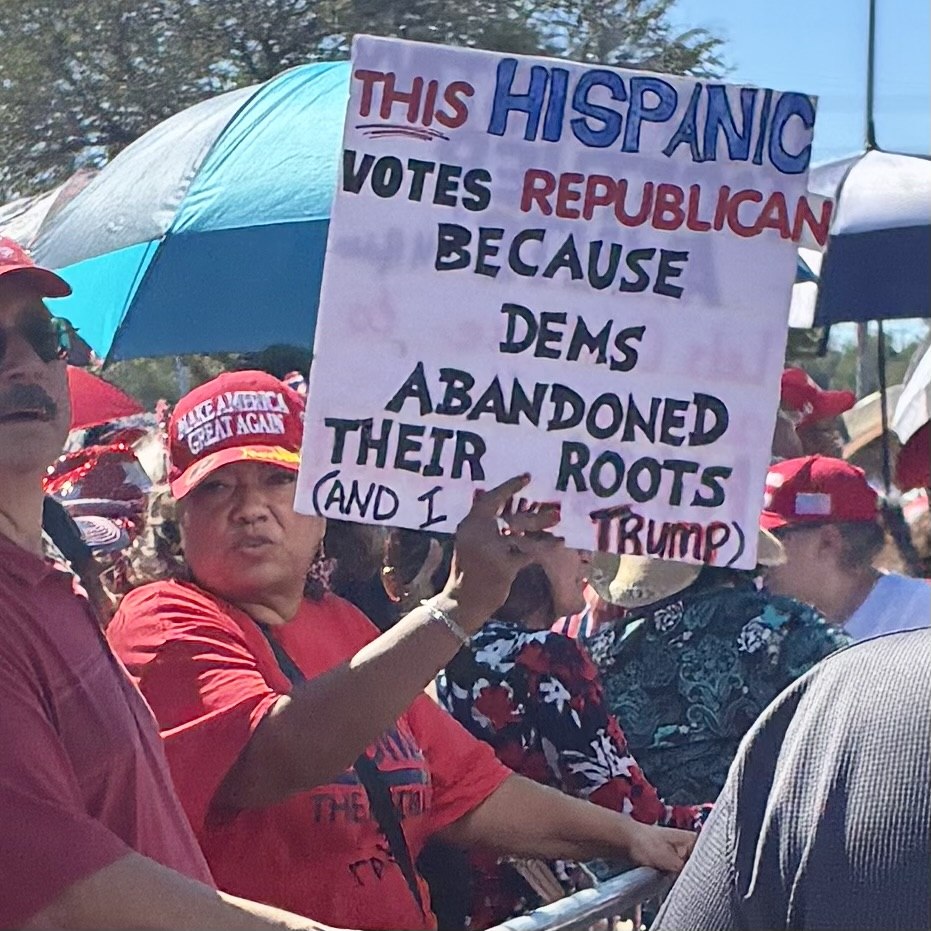
A Trump supporter displays a sign expressing support for the Republican Party during the October 7, 2026, rally in San Antonio. Photo: Christopher Espinoza / Alamo City Post.
Update — November 3: Paxton held a final rally in San Antonio
Paxton’s campaign canceled the planned November 2 stop at the Alamo. Instead, Paxton made a final San Antonio campaign pitch Sunday night, November 1, at The Angry Elephant on the Far North Side, alongside other Republican candidates. The San Antonio Report described a crowd of about 200 and a speech lasting roughly 20 minutes. Read the San Antonio Report’s rally coverage ↗
The Alamo stop had been announced as the finale of Paxton’s Come and Take It bus tour. His November 2 schedule instead listed campaign appearances in Conroe and Allen; his campaign did not publicly explain the change. Read Texas Public Radio’s report on the canceled Alamo stop ↗
“I want to go see the Alamo. I like the Alamo,” bellowed President Donald J. Trump from the stage of his October 7 midterm rally at the Freeman Coliseum in San Antonio, Texas. The line was met with raucous applause from the die-hard Trump supporters in attendance. It was intended to connect the president with his audience, but it revealed not only Texas's high-stakes importance in this year's midterm elections, but also San Antonio's emergence as a center stage for the Republican Party this election cycle.
In 2026, the city's prominence in GOP politics is as novel as the prospect of Texas sending a liberal Democrat to the Senate. This fact is not lost on Ken Paxton's Senate campaign, which this week announced a "Come and Take It" tour throughout the state, culminating at the Alamo on November 2. With Texas's status as a Republican stronghold facing a serious challenge this year, the party, all the way up to the president, is signaling that San Antonio has an important role to play in ensuring Texas remains red.
Several races in Texas are key to Republican efforts to retain control of Congress. At his San Antonio rally, President Trump stumped for several GOP candidates whose elections are critical to the party. Trump brought veteran Carlos De La Cruz onstage and encouraged attendees to support his candidacy for Texas's 35th Congressional District. De La Cruz's sister, Monica De La Cruz, is also fighting to defend her seat in Texas's 15th District. Trump voiced his support for Tano Tijerina during the rally, and conservative firebrand Brandon Herrera spoke before the president took the stage.
The key figure at Trump's rally, however, was Attorney General Ken Paxton, who is in a bitterly close race with Democratic Texas state Rep. James Talarico. The president gave an unequivocal endorsement of the attorney general, praising him as "probably the greatest attorney general in the history of the state of Texas."
Through Trump's visit to San Antonio and Ken Paxton's planned Alamo rally on the eve of the election, the GOP is signaling that San Antonio is central to its efforts to appeal to Texans and keep the state in the Republican camp, at least for this election cycle.
In his opening remarks, Lt. Gov. Dan Patrick recited the lyrics to "The Ballad of the Alamo," recorded by Marty Robbins in 1960 and included on the soundtrack album for John Wayne's film The Alamo, released that same year. His recitation sounded like a beautiful, sentimental poem, and in that moment, I could not help but swell with pride at being a Texan, despite attending the rally not as a supporter of the president or the Republican Party, but as an observer in the press section. I imagine Dan Patrick's recitation had the intended effect on the rallygoers.
The lieutenant governor made further references to the heroes of the Alamo. At one point, he joked that if James Talarico had appeared before Davy Crockett wearing a coonskin cap, the Alamo defender would have told the aspiring senator that the tail belonged at the back of his head.
The president went even further in his invocation of the spirit of the Alamo. He connected Texas's historic identity, particularly its reputation for independence and toughness, with the Texas Republicans running in this year's elections. He presented the Alamo's defenders as symbols of values he argued were incompatible with Talarico's candidacy. Trump name-dropped Davy Crockett, Jim Bowie, and William B. Travis, going on to claim that the Texas heroes would be "rolling over in their graves" at the prospect of Talarico becoming a U.S. senator.
In attempting to contrast what he perceived as Texas values with those held by James Talarico and liberal Democrats, the president demonstrated that he remains a political master of comedy. He referred to Talarico as "Talafreako" and claimed not to know the candidate's real name. He joked about Talarico's veganism and an alleged adverse reaction to eating meat. His comedic bits were reminiscent of Trump's 2016 campaign, when his use of humor and nicknames was central to his political success.
Also reminiscent of his 2016 campaign were the number and frequency of disruptive protesters in attendance. His rhetorical question, "Is there anything like a Trump rally?" brought back memories of the high-energy, raucous rallies of the 2016 election cycle, with chants of "Build the wall!" and "Lock her up!" seared into my memory.
Despite Trump delivering one of the best rally performances I have witnessed, the audience did not seem as energized as those I had encountered in previous election cycles. But the reason seemed clear. No longer was the audience being worked into a frenzy by an eccentric billionaire outsider refusing to stay on message. Instead, they were being asked to vote for party nominees by the sitting president of the United States, who at times read methodically from a teleprompter, signaling the seriousness with which he approached these Texas races.
While the president's visit signals Republican concern about potentially losing Texas in the future, one attendee I spoke with highlighted the gains Republicans have made among Hispanic and young voters, thanks to Donald Trump.
I spoke with Patrick, a 17-year-old Hispanic attendee who was at the rally with his father. I initially asked his father if I could briefly interview him, but he told me he was only there because his son wanted to attend.
I asked Patrick why he wanted to attend a Trump rally. He responded that he liked Trump's eccentric personality and his immigration policies. The latter were highlighted during the rally when Trump brought onstage the president of the National Border Patrol Council, the union representing Border Patrol agents, as well as an "Angel Mom" who spoke about how an illegal alien had ambushed her family and killed her son here in Texas.
I asked Patrick what he thought the future of the GOP would look like when Trump was no longer president. He said he was uncertain but would likely support Vice President JD Vance should he decide to run for president. He added that, thanks to Trump, he intended to remain engaged in Republican politics.
Despite the Texas Senate race being exceptionally close, Trump's influence within the GOP may continue to prove useful in attracting enough Hispanic voters and young men to keep Republicans in control of Texas for the next few election cycles.
For their part, San Antonio and the Alamo may continue to serve as important political resources for Republicans statewide. With Ken Paxton's planned Alamo rally on the eve of the election, Republicans are finally giving attention to a city that, by many accounts, helps define Texas culture, but whose local GOP apparatus has tended to be overshadowed by Republican organizations in the Houston and Dallas–Fort Worth areas.
This year, San Antonio is receiving a level of Republican recognition it has rarely enjoyed in previous election cycles. History suggests that wherever Donald Trump goes, the Republican Party follows. And when the president says he wants to see the Alamo, the evidence suggests that, this midterm year, the Republican Party is following him there.
Whether the city's GOP can capitalize on that attention remains to be seen.